Designing a commercial kitchen isn’t just about fitting equipment into a room, it’s about creating a space where food prep, cooking, and plating happen smoothly even during the dinner rush. Whether you’re opening a restaurant, upgrading a catering operation, or designing a shared kitchen facility, the layout, equipment, and systems you choose will directly impact your bottom line. This guide walks you through the essentials: workflow zones, equipment selection, compliance standards, and budget planning. You’ll learn how to assess your specific needs, avoid costly mistakes, and build a kitchen that actually functions the way you need it to.
Table of Contents
ToggleKey Takeaways
- A well-designed commercial kitchen requires strategic workflow zoning—separating receiving, prep, cooking, plating, and cleanup zones—to minimize cross-traffic and improve both efficiency and food safety.
- Proper equipment sizing based on peak capacity (covers per service and cook time) is critical; undersized equipment creates bottlenecks even in adequately-sized kitchens, directly impacting profitability and staff morale.
- Commercial kitchen design must prioritize non-negotiable elements: ventilation systems with ansul fire suppression, proper refrigeration, and code-compliant utilities before investing in decorative finishes.
- Budget 25-30% of your total restaurant footprint for kitchen space, with costs typically ranging from $250-$1,000+ per square foot; equipment usually represents 40-60% of the total budget.
- Purchasing used commercial-grade, NSF-certified equipment from liquidators can reduce costs by 30-50%, but inspecting equipment personally and prioritizing new ventilation systems prevents costly repairs and safety issues.
- Professional kitchen consultants and designers pay for themselves by preventing code violations, equipment mistakes, and workflow inefficiencies that would cost far more to fix after construction.
Understanding Commercial Kitchen Layouts and Workflow
Commercial kitchen design revolves around the flow of food, from receiving and storage, through prep and cooking, to plating and pass-out. The three main layout types are linear (galley-style), L-shaped, and U-shaped, each suited to different operations and space constraints.
Linear kitchens work well for smaller operations or counter-service concepts with limited menu items. All stations run in a line, which minimizes movement but can create bottlenecks during peak service. L-shaped kitchens add flexibility by using two perpendicular walls and are popular for mid-sized restaurants. U-shaped designs maximize efficiency by allowing multiple cooks to work simultaneously without crossing paths, ideal for high-volume operations.
The core principle is zoning: separate stations for receiving, dry and cold storage, prep, cooking, plating, and dish cleanup. Each zone should be positioned to minimize steps and cross-traffic. For example, the cooking line sits between prep and the pass window, not across the kitchen. Plating happens near the pass, and dirty dishes flow directly to the wash station, keeping soiled equipment away from food prep areas.
Work with your chef, kitchen manager, or head cook when mapping out zones. They know the actual workflow and can spot inefficiencies you might miss. A well-designed kitchen reduces fatigue, speeds service, and cuts waste, directly improving profitability and food quality.
Assessing Your Space and Operations
Before buying a single piece of equipment, measure your kitchen footprint and understand your operational needs. Sketch the space to scale (1/4 inch = 1 foot is standard) and note windows, doors, utilities, loading areas, and existing walls or columns.
Answer these questions: How many covers (meals) do you serve per service? Do you cook on-premises or reheat prepared food? What’s your menu complexity, burger-and-fries or multi-course tasting menus? Will you prep during service or pre-batch everything? Your answers determine equipment size and type.
A 2,500-square-foot restaurant typically needs 500–700 square feet of kitchen space. But, a high-volume lunch counter might operate in 150 square feet, while a fine-dining kitchen preparing complex dishes could need 900+ square feet. The rule of thumb: kitchen size should be 25–30% of your total restaurant footprint, but this varies significantly based on volume and menu.
Document peak capacity: if you serve 200 covers on Saturday night and the average entrée takes 12 minutes on the line, you need cooking equipment sized for that throughput, not an average. Understaffed kitchens fail not because they’re too small but because the equipment can’t match demand. Budget time for a professional kitchen consultant if your operation is complex or your space is tight, the investment pays off in months.
Essential Equipment and Appliances for Commercial Kitchens
Every commercial kitchen needs the big three: a cooking line, refrigeration, and preparation surfaces. Within these categories, choices vary wildly based on your menu.
Cooking Equipment starts with the range or cooktop. A standard 6-burner range with oven (36 inches wide) is the baseline for most restaurants: larger operations use 8-burner ranges or modular cooking suites. If you grill frequently, add a dedicated charbroiler or flat-top griddle. Fryers, tilting skillets, steam kettles, and convection ovens become essential depending on your menu. Commercial equipment is rated in BTU output (British Thermal Units) and cook power, higher numbers mean faster cook times and better recovery between orders.
Refrigeration includes reach-in coolers, undercounter units, and walk-in freezers and coolers. A typical 4-door reach-in cooler (72 inches wide) holds about 20 cubic feet and costs $3,000–$5,000 new. Walk-ins are custom-sized modular units that start around $8,000–$12,000 installed but offer massive capacity and efficiency gains. Undercounter units maximize bench space.
Prep Tables (24 or 30 inches deep, various widths) provide the work surface where most prep happens. Choose stainless steel tops (industry standard) and ensure electrical outlets and hand-sink access are within arm’s reach. Commercial dishwashing requires either a low-temp or high-temp hood-type washer ($4,000–$15,000) or a pass-through unit for smaller operations.
Ventilation is non-negotiable. A commercial exhaust hood with ansul suppression system (fire suppression) must sit above your cooking line. Hood sizing depends on your BTU output: undersized hoods leave smoke and grease in your dining room. Budget $5,000–$25,000 for hood and makeup air system installation.
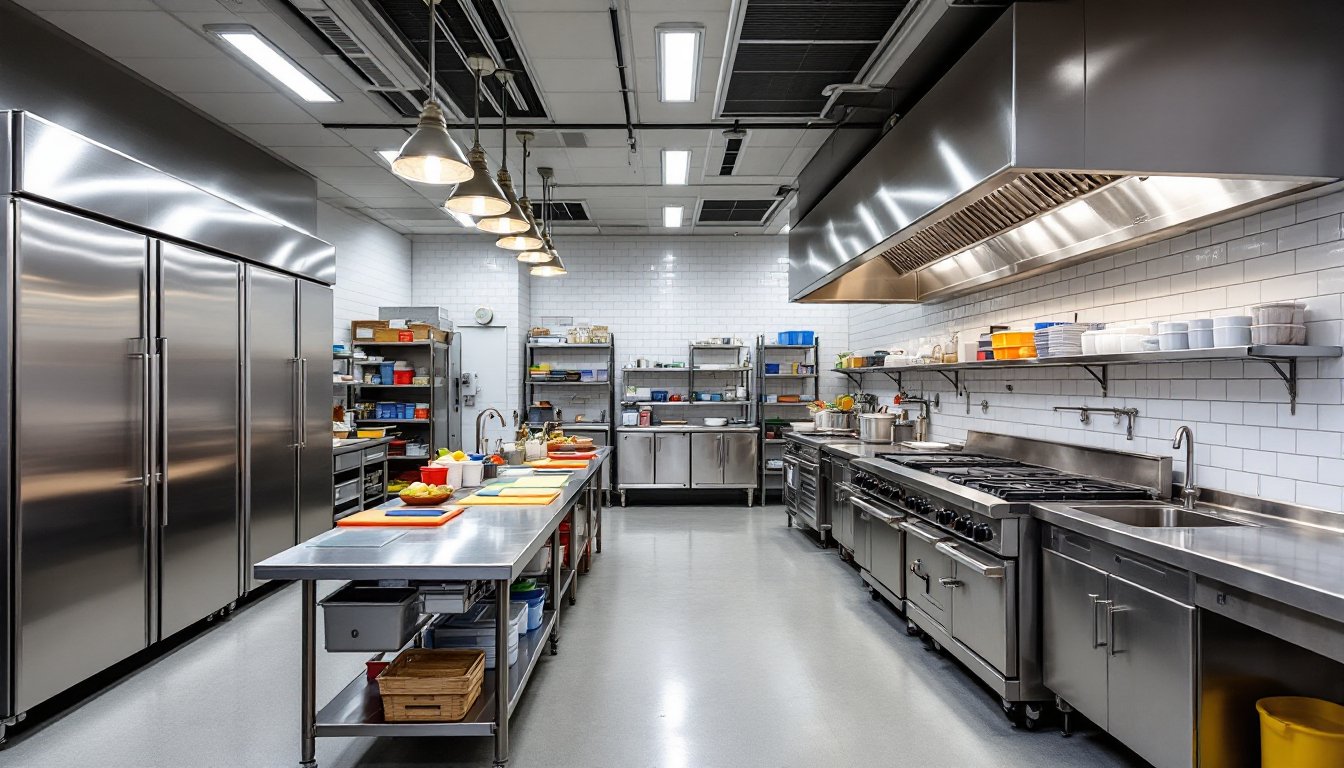
These practical ideas from professional kitchens show how commercial solutions scale down for shared facilities or larger homes. Always buy commercial-grade equipment rated for NSF (National Sanitation Foundation) certification, consumer-grade appliances fail quickly under commercial duty cycles.
Storage, Prep Areas, and Organization Systems
Storage is where many kitchens fall short. You need dry storage (spices, flour, dry goods, cool, dark, 60–70°F), cold storage (produce, proteins, sauces), and frozen storage, plus chemical storage (sanitizers, cleaners) isolated from food. Many codes require shelving 6 inches off the floor to allow cleaning underneath, open shelving is easier to inventory than cabinets but requires disciplined rotation (FIFO: first in, first out).
Prepare for mise en place (ingredient setup) by organizing your stations. Prep cooks should reach raw ingredients, cutting tools, and portion containers without stepping more than 2–3 feet. Vertical space matters: wall-mounted shelves and pot racks free up counter area. Rolling carts and mobile prep tables add flexibility for high-demand days.
Label everything. Use permanent markers or date-gun labels on all containers with contents, date, and expiration. Many food safety violations come from unmarked leftovers and mystery containers. Invest in a few cambro containers (clear, stackable, durable), they’re not expensive but cut waste and improve organization dramatically.
Cross-contamination prevention requires designated prep areas: raw proteins separate from vegetables, allergen stations isolated. This often means multiple cutting boards, color-coded for safety. Install a hand-sink (not a dish sink) within 10 feet of each major prep area for staff handwashing, local codes will specify minimum counts and placement. Running out of hand-sink access mid-service leads to unsafe shortcuts.
Safety, Compliance, and Ventilation Standards
Commercial kitchens are heavily regulated. Your design must comply with local health department codes (vary by jurisdiction), building codes (IRC, International Residential Code, or ICC standards for commercial), and fire codes. Hire a kitchen designer or consultant familiar with your jurisdiction early, building violations cost far more than planning.
Flooring must be non-slip and drain toward a floor sink: many codes require epoxy or sealed concrete. Wall surfaces near cooking areas need tile or washable surfaces up to 4 feet high. Grease traps are mandatory if you cook fatty foods: they prevent buildup in municipal sewer lines and require regular pumping.
Ventilation is critical. The exhaust hood must remove heat, smoke, and grease vapor: undersizing it leaves you with a dangerous, greasy kitchen. Makeup air (replacement fresh air) must enter to prevent negative pressure. Many codes require ansul systems (automatic fire suppression) above cooking equipment. Poorly designed ventilation drives up energy costs and creates fire hazards.
Electrical service in a commercial kitchen is substantial. Most restaurants need a 200-amp or larger service, with dedicated circuits for high-draw equipment like fryers and ovens. Outlet placement matters: wall outlets, floor boxes, or overhead drops must be positioned to avoid extension cords across walkways (tripping hazard and fire risk).
Hot water for cleaning and dishwashing usually requires a commercial water heater sized to meet demand during peak hours. Cold water filtration often improves equipment lifespan and product quality. Grease, sediment, and minerals shorten equipment life, budget for a basic sand/carbon filter or reverse osmosis system.
Permits are not optional. Unpermitted work voids insurance, creates liability, and fails health inspections. Budget 4–8 weeks for permitting and inspection, especially for structural changes or utility work.
Budget Planning and Cost-Saving Strategies
Commercial kitchen buildout costs vary wildly: $250–$1,000+ per square foot depending on region, finishes, and whether you’re building from scratch or renovating. A modest 400-square-foot kitchen (small café or food truck prep) costs $100,000–$200,000. A 700-square-foot full-service restaurant kitchen can run $350,000–$600,000 or more.
Equipment is typically 40–60% of the budget. A used commercial 6-burner range costs $1,500–$3,000 versus $4,000–$6,000 new. Restaurant supply liquidators and auction sites often have quality used equipment at 30–50% off retail. Verify that equipment is NSF-certified and inspect it personally, used doesn’t mean cheap if repairs are needed.
Prioritize essentials first: cooking equipment, refrigeration, and ventilation are non-negotiable. Decorative finishes and premium fixtures come later. A stainless-steel shelf is $150: a custom backsplash is $3,000. Choose function over aesthetics initially.
Phase the project if budget is tight. Start with core cooking and prep zones: add reach-in coolers and prep tables in phase two: install the walk-in and advanced equipment later. This keeps cash flow manageable and lets you adjust designs based on how the initial kitchen performs.
Negotiate with suppliers on volume. A restaurant buying 10 pieces of equipment at once has leverage. Don’t skip the ventilation or ansul system to save money, these are code-mandated and fire-safety-critical. Cutting corners here invites failure and liability. Design to your actual needs, not aspirations: oversizing equipment wastes money and energy: undersizing creates bottlenecks and staff frustration. Work with a kitchen designer or experienced operator to right-size every piece.
Conclusion
A well-designed commercial kitchen balances workflow efficiency, code compliance, and budget reality. Start with your operational needs, volume, menu, and space, then map zones, select appropriately-sized equipment, and plan for ventilation and utilities. Hire professionals (kitchen designer, consultant, or architect) for complex projects: the cost is recoverable through better design and avoided rework. Phase your budget wisely, invest in essentials, and don’t skip safety or compliance. Your kitchen is your production engine: design it to run smoothly, not just to look good.